This post helps small contractors get a better handle on receipts, labor hours, and job costs with simple systems that work for their crew and their business. It shows how a few consistent habits can help them understand where their money is going and gives them a starting point for getting organized without making things more complicated.
Busy Contractor? Here's How to Keep Track of Where the Money Goes
Let's face it. When you first started out, keeping track of the money wasn't all that complicated. You knew what you bought, what job you were working on, and roughly what everything cost. You were doing most of it yourself.
Then business picked up.
You've got a few guys working for you now. You've got more jobs going, more materials being bought, more receipts coming in, and a lot more moving parts.
That's a great feeling. You've built something.
But here's the catch: the bigger your business gets, the harder it becomes to keep track of everything yourself.
Receipts get lost. Expenses get lumped together. You look at your bank account and see money coming in and money going out, but you're not always sure exactly where it went.
And when you can't see where the money is going, it's hard to know which jobs are making money, whether you're charging enough, or where you might be losing it.
The answer isn't to create a mountain of paperwork or spend your nights doing office work.
It's to come up with a simple system that works for you and gets your crew on board.
Here are a few places to start.
1. Get Your Guys on Board With Receipts
You can't be everywhere at once. If your guys are buying materials, picking up supplies, or making purchases for different jobs, you need a way to know what those purchases were for.
You need two things from them:
The actual receipt.
The name of the job the purchase belongs to.
That's it. Start there.
The trick is making it easy enough that your guys will actually do it.
Here are two simple approaches you could try:
Option A: The Receipt Box
If your crew regularly brings receipts back to the shop, keep a dedicated box or folder in a place where everyone can find it.
Give them one simple instruction: Write the job name on the receipt before you drop it in the box.
That's the system.
When you're ready to sort through the receipts, you know which job each purchase belongs to. You're not left trying to remember which project needed those supplies three weeks ago.
This works especially well if your guys come back to the shop regularly and prefer keeping things on paper.
Option B: Take a Picture and Send It
Sometimes a receipt gets tossed in the truck, stuffed in a pocket, or left on the dashboard. By the time you get around to collecting it, nobody remembers what it was for.
You know how it goes. If you don't deal with it right away, that receipt becomes a forgotten artifact.
Try this instead.
Before leaving the store, have your guys write the job name directly on the receipt, take a picture, and text or email it to whoever handles your office work.
A shared email inbox or a designated phone number can make this even easier to manage.
The key is to keep the process simple and consistent. The receipt needs to be readable, the job name needs to be clear, and someone needs to make sure it gets recorded.
Which System Is Right for You?
That depends on how your business operates.
If everyone comes back to the shop, a receipt box might be all you need. If your guys head straight from one job to another, taking a picture and sending it may work better.
You could even use both.
Whatever you choose, explain the process to your crew and stick with it. Make it part of the routine, just like cleaning up at the end of the day.
A little consistency here can save you a lot of guessing later.
2. Start Tracking What Each Job Actually Costs
Getting receipts organized is a great first step. But knowing what you spent isn't enough if you don't know which job the expense belongs to.
Let's say you've got three jobs going at once. Materials are being purchased, your guys are moving between sites, and a subcontractor is working on one project while you're wrapping up another.
At the end of the month, your books might show plenty of expenses. But can you tell how much each job actually cost?
That's where things get tricky.
If you want to know whether a job made money, you need to connect the costs to the job.
You don't have to start with complicated software or a fancy spreadsheet. Start with the information you already have and build a process around it.
Materials and Supplies
This is where the receipt system pays off. When you record a purchase, assign it to the correct job.
If a purchase covers more than one project, split the cost between them using a reasonable method. Don't charge the entire purchase to whichever job happens to come to mind first.
Labor: Where Did Your Guys Spend Their Time?
This one can be harder.
If you have employees working on multiple jobs during the week, how do you know how much labor belongs to each project?
You need a way to track their time by job. Here are two approaches that might work for your crew.
Keep it simple!
Option A: Add a Simple Job Note to Payroll
Whatever payroll or time-tracking app you use, see if your employees can add a basic note showing where they worked.
For example:
Monday: 4 hours — Smith kitchen; 4 hours — Jones bathroom.
Tuesday: 8 hours — Smith kitchen.
Wednesday: 3 hours — Jones bathroom; 5 hours — Smith kitchen.
You don't necessarily need a complicated time-tracking system. You need a reliable record of where the hours went.
If your current app supports job codes or project tracking, even better. You may already have a tool that can do much of the work.
Option B: Keep a Simple Weekly Job Schedule
If your crew follows a fairly predictable schedule, create a weekly sheet showing who is assigned to which job and when.
Use it as a reference when reviewing payroll and assigning labor costs.
For example, if an employee spent Monday and Tuesday on one project and Wednesday through Friday on another, the schedule gives you a starting point for allocating those hours.
Just remember that a schedule shows where someone was supposed to work, not necessarily where they actually worked. If plans change during the week, update the schedule or have your guys note the changes.
Whichever method you choose, make sure it captures actual time worked and meets your payroll recordkeeping requirements. A little information recorded consistently is far more useful than trying to reconstruct an entire month from memory.
Don't Forget the Other Job Costs
Materials and labor are only part of the picture.
Depending on the project, you may also have:
Subcontractor costs.
Equipment rentals.
Delivery charges.
Permits and other project-specific expenses.
Keep these costs tied to the right job, too.
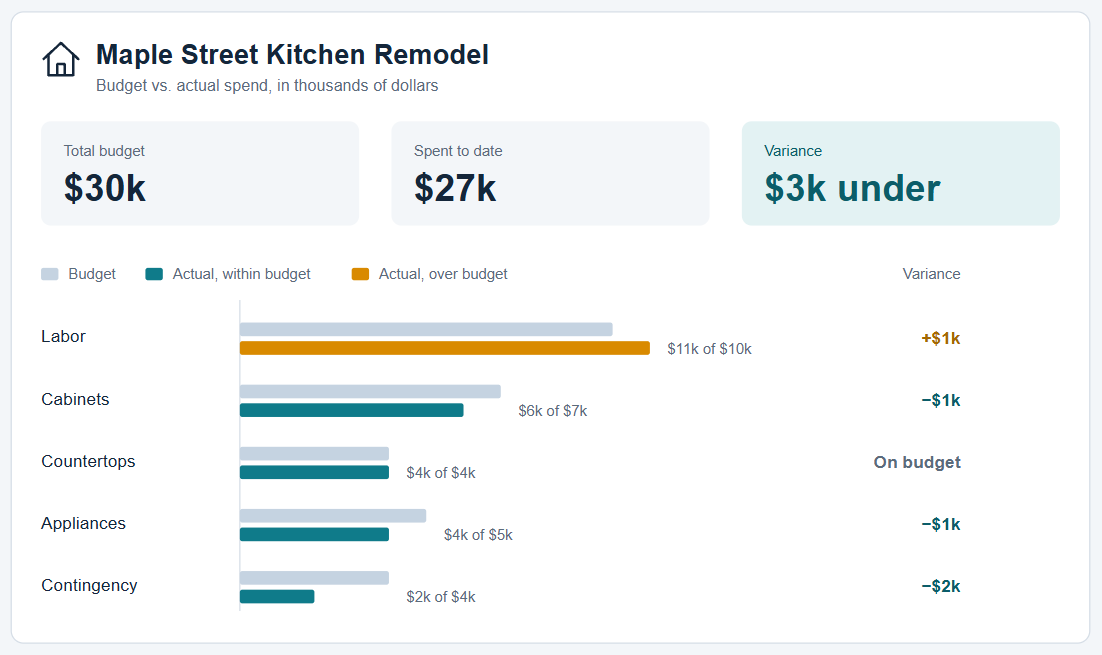
Once you have a reliable picture of the major expenses, you can start comparing what you expected a project to cost with what it actually cost.
That's when the information becomes useful.
You may discover that certain types of jobs consistently take longer than expected. Maybe material costs are higher than you thought, or the hours you're spending on a project aren't reflected in your original estimate.
You can't fix what you can't see.
And you can't make good pricing decisions if you don't have a reasonably accurate picture of your costs.

3. Make Time for the Business Side of Your Business
We get it. When you've got jobs to finish and customers waiting, sitting down to organize receipts and review expenses isn't exactly at the top of your list.
But if you leave everything until you have a free weekend, chances are you'll spend that weekend trying to catch up instead of getting ahead.
You don't need to spend hours in the office every day. You need a routine that keeps the work from piling up.
Try starting with something like this:
Once a week:
Collect receipts and make sure job names are included.
Record new expenses and assign them to the right jobs.
Review employee time records and note which projects the hours belong to.
Check which customer invoices are still outstanding.
Once a month:
Reconcile your bank and credit card accounts.
Review expenses and look for missing receipts or transactions.
Check how your active jobs are tracking against their budgets.
Look at upcoming bills and expected customer payments.
Identify anything that needs attention before it becomes a bigger problem.
You can adjust this routine to fit the way you work. Maybe Friday afternoon is the best time to gather everything. Maybe your office work happens first thing Monday morning.
The point is to make it a regular part of running the business.
And if you're spending too much of your own time doing it, that's worth paying attention to as well. Your time has value, too.
You Don't Have to Figure It All Out Yourself
Every contracting business is a little different.
The right system for a two-person carpentry crew isn't necessarily the right system for a contractor managing several crews and multiple projects. Some guys want everything on their phones. Others would rather have a sheet of paper and a place to put their receipts.
That's why we don't believe in handing every contractor the same complicated system and expecting it to work.
At Pine & Anchor Contractor Support, we help small contractors and owner-operators get the business side of things under control.
We can help you put a practical process in place for tracking receipts, organizing expenses, allocating job costs, reviewing your numbers, and keeping up with the office work that tends to fall behind when you're busy.
With experience organizing construction businesses of all sizes, from small owner-operated crews to larger operations, we understand that there is no one-size-fits-all solution. Every contractor runs their business differently, and what works for one crew may not work for another. We'll work with you to build a system that fits your business, your crew, and the tools you already use. Whether you need help getting started, cleaning up what you already have, or ongoing back-office support, we can tailor our services to meet your needs.
And we can help handle the day-to-day back-office work, so you're not left trying to do it all yourself after a long day in the field.
You don't need a perfect system. You need one that works for you, gives you better information, and makes running your business a little easier.
You've worked hard to build your business. Let's make sure you can see how it's doing.
Contact Pine and Anchor Contractor Support to talk about what's falling through the cracks and how we can help you get things organized.
